
Poem Maker
Poetry forms are like puzzles: a haiku needs 5, 7 and 5 syllables, a limerick needs a bouncing rhythm and an AABBA rhyme, an acrostic spells a word down the side. This poem maker shows you the pattern for each form, counts syllables as you type, suggests rhymes, and can generate an example to get you started — then prints your finished poem as a card.
- Free to use
- No sign-up
- Runs in your browser
Poem maker
Poetry Forms Worksheet Pack
Printable poetry worksheets for haiku, acrostic, limerick, cinquain, diamante and “I am” poems, each with an example, a planning box and a final-copy page, plus syllable practice and a poem display card.
- Haiku worksheet (PDF/DOCX)
- Limerick worksheet (PDF/DOCX)
- Cinquain worksheet (PDF/DOCX)
- Diamante worksheet (PDF/DOCX)
- I Am Poem worksheet (PDF/DOCX)
- Acrostic worksheet (PDF/DOCX)
- Syllable practice (PDF, DOCX)
Formats: PDF, DOCX. Instant download after payment (link valid 72 hours, up to 5 downloads). AI-assisted: the templates were drafted with AI help and reviewed and laid out before publishing.
$5.00 USD, one-time 7 files · about $0.71 each
- Instant download
- 7-day refund
- Secure checkout by Stripe
7-day money-back guarantee. Full refund within 7 days of purchase, even after you download.
Free sample: Haiku Worksheet (PDF, 99 KB)
Full refund within 7 days — see the refund policy and license.
Free printables
Single sheets you can print right now, no sign-up. The full pack adds every sheet in one download plus the editable files.
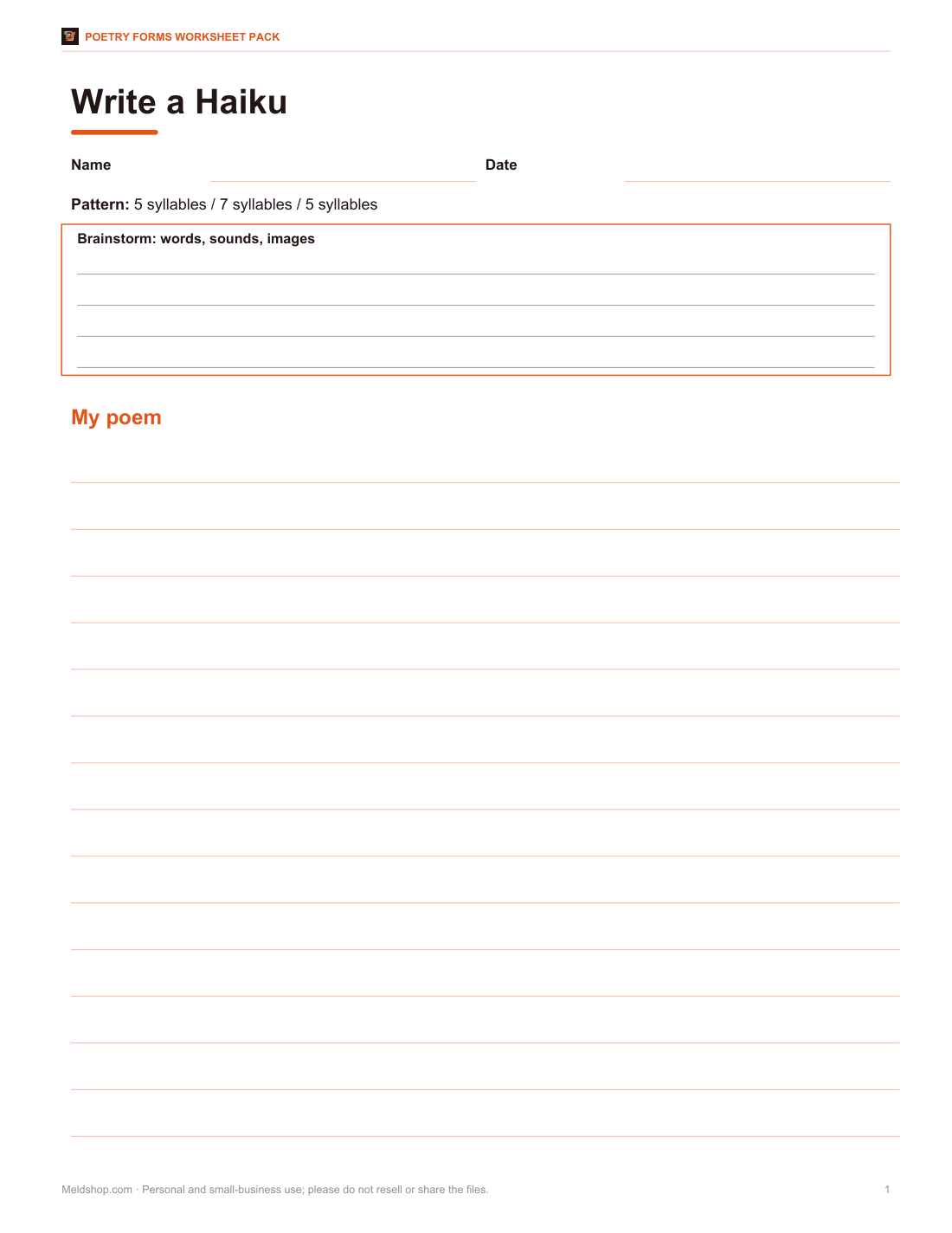
 Printable Haiku Worksheet2 pages · free PDF
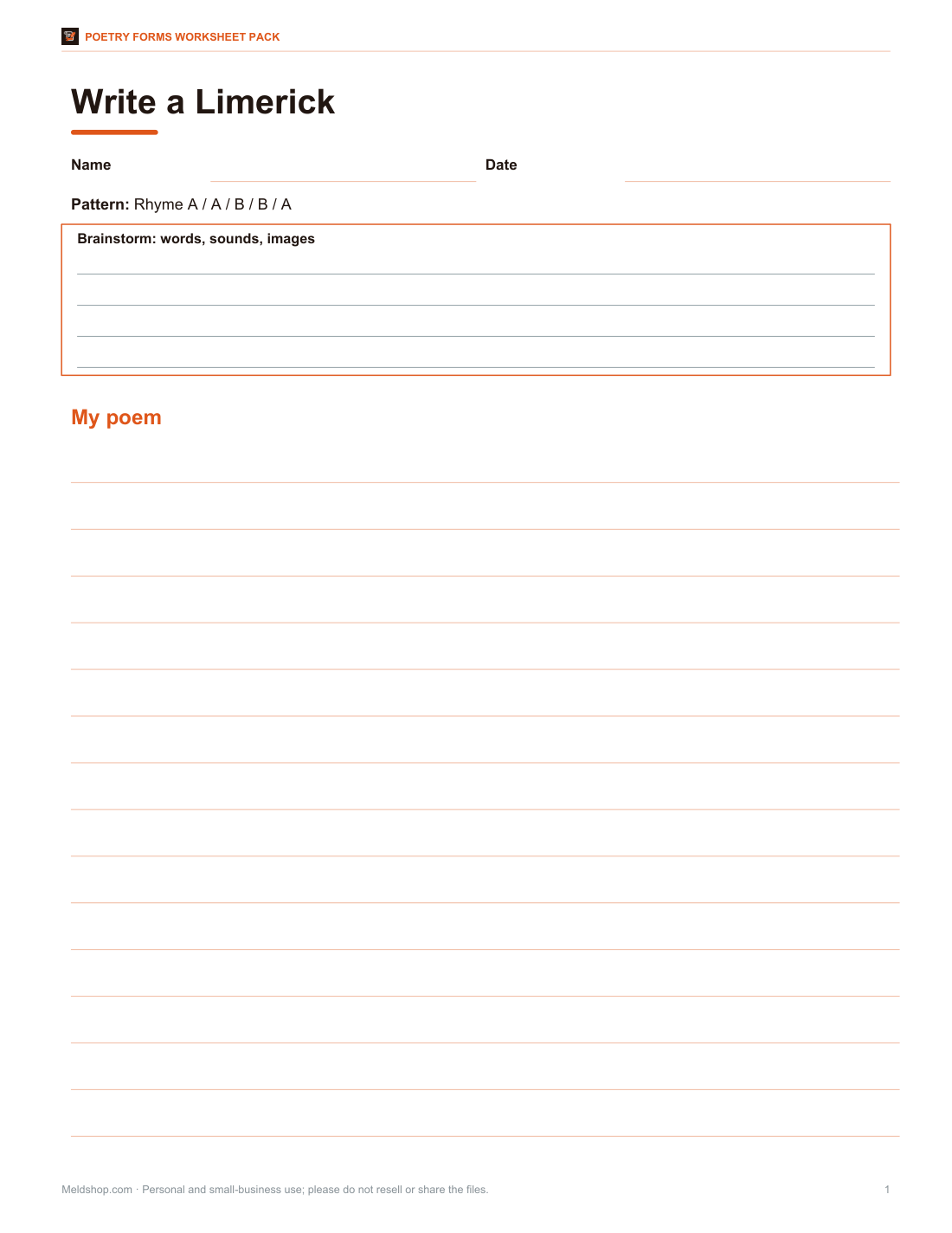
 Printable Limerick Worksheet2 pages · free PDF
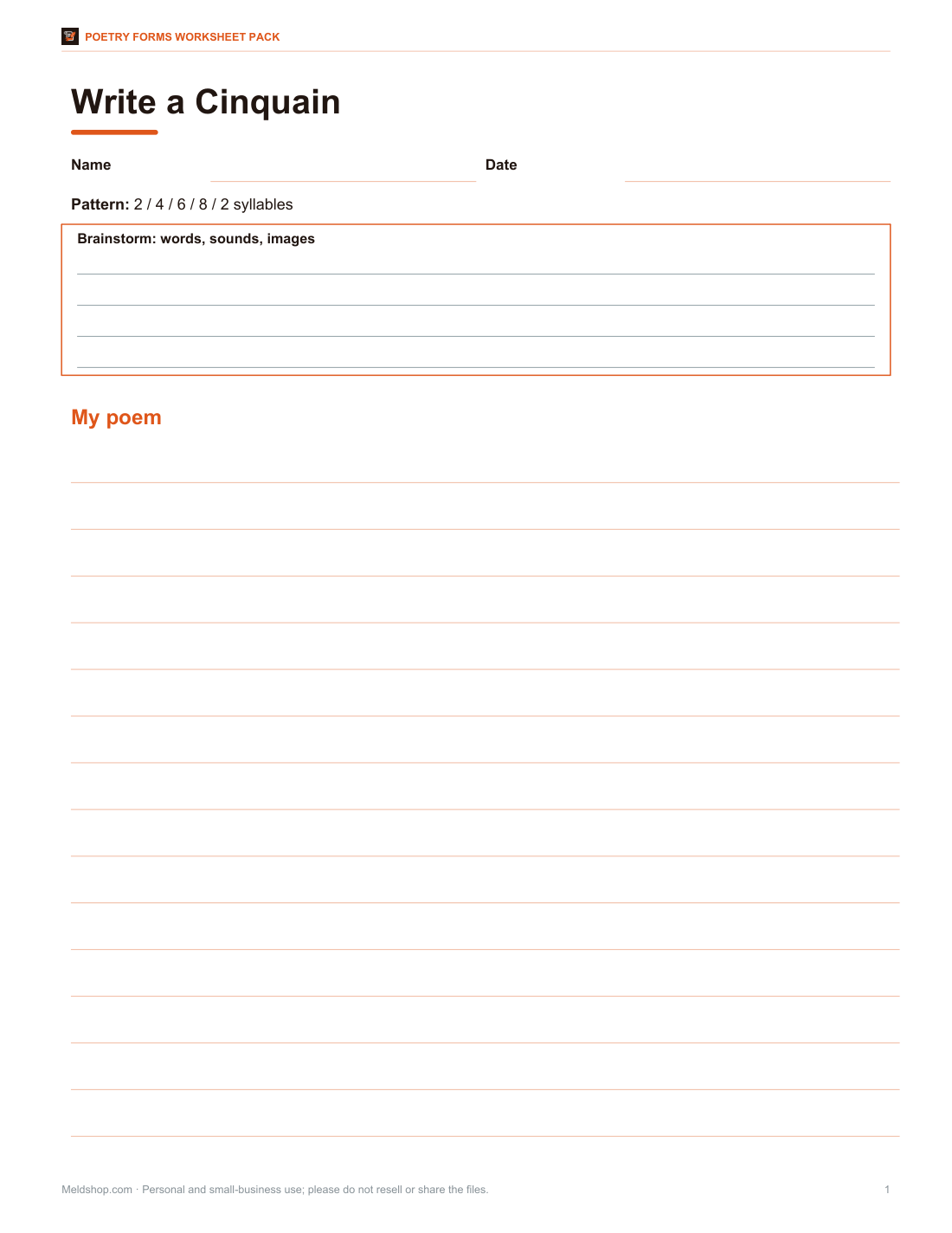
 Printable Cinquain Worksheet2 pages · free PDF
 Printable Diamante Poem Worksheet2 pages · free PDF
 Printable I Am Poem Worksheet2 pages · free PDF
 Printable Acrostic Poem Worksheet1 page · free PDF
 Printable Syllable Practice Worksheet2 pages · free PDF
Poem forms at a glance
| Form | Pattern | Good for |
|---|---|---|
| Haiku | 3 lines: 5, 7, 5 syllables | A single moment, often in nature |
| Acrostic | First letters spell a word | Names, seasons, topics |
| Limerick | 5 lines, AABBA, bouncy rhythm | Funny stories |
| Cinquain | 5 lines: 2, 4, 6, 8, 2 syllables | Short, focused images |
| Diamante | 7 lines in a diamond, opposite to opposite | Contrasts: day/night, summer/winter |
| “I am” poem | Lines start with prompts: I wonder, I hear… | Writing about yourself |
How to use the poem maker
- Choose a form; the pattern for each line appears as a label.
- Type your lines — the syllable count updates as you go.
- Stuck? Click “Generate an example” to see a sample, then change it into your own.
- Use the rhyme helper for limericks and rhyming lines.
- Download your poem as text or print it as a card.
Counting syllables
A syllable is a beat in a word: “sun” has one, “sun-light” two, “but-ter-fly” three. Clapping as you say a word is the easiest way to count. The poem maker counts automatically using spelling rules, which work for most words but can be off by one for unusual ones (“fire”, “poem” and “every” are pronounced differently by different people), so trust your ear when the count looks wrong.
Worked example: a haiku
- Pick a moment: early morning by a river.
- Line 1, five syllables: “morning mist rises” (mor-ning mist ri-ses = 5).
- Line 2, seven syllables: “a single leaf spins downstream” (a sin-gle leaf spins down-stream = 7).
- Line 3, five syllables: “the creek hums softly” (the creek hums soft-ly = 5).
- Read it aloud and adjust words until it flows.
Writing a limerick
Limericks have a rhythm that sounds like da-DUM-da-da-DUM-da-da-DUM: three strong beats in lines 1, 2 and 5 and two in lines 3 and 4. Start with a character and a place (“There once was a cat from the bay”), find two more rhymes for the long lines, then use the short lines for the middle of the story. The last line should deliver the joke or twist.
Writing an acrostic that sounds like a poem
The easiest acrostics use one word per letter, but the best ones read as sentences that flow across the lines. Choose your word, jot down five ideas connected to it, then look for ideas that begin with the letters you need. Lines can run on into each other — for SNOW: “Silent flakes / Now cover the car, / Our garden, the gate, / While we sleep.” Reading the lines aloud without the capital letters is a good test.
Cinquain and diamante step by step
- Cinquain: choose a one- or two-word subject for line 1 (two syllables).
- Describe it in line 2 (four syllables) and show it moving in line 3 (six).
- Line 4 (eight syllables) gives a feeling or a thought about it.
- Line 5 (two syllables) renames or sums it up.
- Diamante: pick two opposites, such as summer and winter.
- Work from the first noun down to the middle line, then from the last noun up — the fourth line is where the poem turns from one to the other.
Where haiku come from
Haiku grew out of Japanese linked verse and became an independent form with poets such as Matsuo Bashō in the 17th century. Japanese haiku count sound units (on) rather than English syllables, so many modern English-language haiku poets write shorter poems than 5-7-5, focusing instead on a single vivid image and a moment of noticing. The 5-7-5 pattern remains a useful starting structure, especially for learners.
Tips for better poems
- Show, don’t tell: “my hands are shaking” says more than “I am nervous”.
- Use specific nouns: “a robin” rather than “a bird”.
- Cut words that don’t earn their place, especially in short forms.
- Read the poem aloud — your ear will catch awkward rhythm.
- Break the rules on purpose once you know them.
Sharing and displaying poems
A finished poem deserves an audience. Print it as a card and add a small drawing, read it aloud at dinner or in class, or collect a set of poems into a handmade booklet. Displaying haiku next to photographs of the moment they describe is a simple, striking classroom wall.
For teachers and parents
Short forms suit all ages: acrostics and “I am” poems work from about age six, haiku and cinquains from around eight, and limericks from about nine when children can hear rhythm. The printable pack includes worksheets for each form with a planning box, an example and a space for the final draft, plus a syllable-counting practice sheet.
AI-assisted content
Examples and explanations were drafted with AI assistance and reviewed before publishing. The example poems on this page are original.
Frequently asked questions
How many syllables are in a haiku?
17: lines of 5, 7 and 5.
What is the rhyme scheme of a limerick?
AABBA.
What is an acrostic poem?
A poem where the first letters of each line spell a word.
What is a diamante poem?
A seven-line diamond-shaped poem that moves from one subject to its opposite.
Is the syllable counter exact?
It is accurate for most words but can be off by one; check by clapping.
Can I print my poem?
Yes, print it as a card or download it as text.
What should a haiku be about?
Traditionally a moment in nature, often with a hint of the season.